Aesthetic surgery

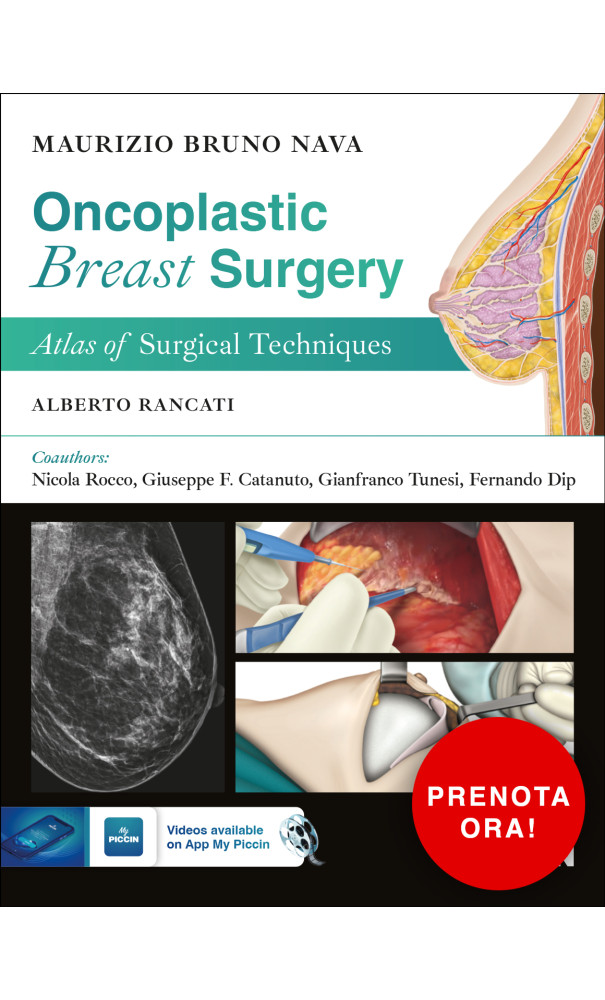
Oncoplastic Breast Surgery. Atlas of Surgical Techniques

Autores : Maurizio Bruno Nava, Alberto Rancati

370,00 €

  • maggio 2026
  • 978-88-299-3572-7
  • 1400904
  • 500 páginas
  • Cartonato

Prologue

The mammary gland, more commonly referred to as the breast even if erroneously, is a gland with holocrine secretion, deputed to the secretion of milk; in our culture it refers to emotional and psychological experiences involving the spheres of femininity, motherhood, sexuality and even aesthetic values. The breast in fact is a concavity, from the Latin sinus, and anatomically it is exactly the space between the two breasts.

Throughout human history, the depiction of the breast has been a subject explored by artists, poets, and scholars alike. It has been immortalized in the strokes of painters, the chisels of sculptors, and the verses of poets, while also undergoing meticulous study both in its aesthetic form and structural intricacies, as well as in its pathological manifestations.
Notable works such as the sculpture “Artemis Ephesia,” the painting “The Origin of the Milky Way” by Tintoretto, and the poem “Exotic Perfume” by C. Baudelaire stand as timeless examples of how the breast has been celebrated and contemplated across different artistic mediums. However, beyond its artistic and aesthetic significance, the breast holds profound sociocultural implications that have shaped women’s lives for centuries, often constraining their autonomy. These implications persist today across various social strata. Therefore, in the context of this discourse, the paramount importance lies in acknowledging and integrating the woman’s agency in decision-making processes, particularly concerning surgical interventions. This shared decision-making approach ensures that the woman remains at the forefront of considerations, guiding the diverse choices in surgical treatments.
The Edwin Smith Papyrus stands as the oldest surviving medical treatise, providing a remarkable glimpse into ancient medical practices. Penned in Hieratic script during Egypt’s Second Intermediate Period, roughly around 1600 B.C., it predominantly delves into surgical matters. Notably, amidst its contents, there are eight mentions of breastrelated ailments. Of significant historical importance is its detailed description of a breast tumor, marking a pivotal moment in the annals of medical history as the earliest recorded account of such a condition.
Over the centuries, we’ve amassed a wealth of written records chronicling the evolution of anatomical, physiological, and pathological studies related to the breasts, alongside advancements in surgical techniques across ablative, reconstructive, and cosmetic domains. For a comprehensive exploration, one might refer to A. Pulchinotta’s enlightening work, “Storia illustrata della senologia fra scienza e mito”. 
In crafting this treatise, our aim was to depart from the traditional medical or surgical textbook format. While these texts undeniably play a crucial role in expanding knowledge, we sought to offer something refreshingly different: a visually immersive experience. Through a meticulously curated collection of drawings, photographs, and microfilms, our intent is to provide surgeons with immediate access to optimal surgical solutions. Moreover, we’ve structured the content to facilitate swift navigation, ensuring ease of reference throughout the entire planning and material selection process.
I am a surgeon, and I have always thought that it is essential for us to “see” and thus be able to intuitively grasp anatomy and reproduce surgical technique with precision. I vividly recall my days as a student that I could not figure out how and where the retrocavity of the epiploons was situated, which seemed elusive within the pages of anatomy textbooks alone. But immediately it was revealed to me when, while still a student, I witnessed surgery on the abdomen at the National Cancer Institute where I was trained as a general surgeon and oncologist, and since the late 1980s as I transitioned as a reconstructive plastic surgeon, particularly focusing on breast procedures, I was fortunate to meet and learn from exceptional mentors, whose names I intentionally withhold, and whom I want to thank here for what they taught me, and by instilling broader lessons that transcend the specific field of surgery and medicine

Introduction to reading

Allow me to guide you through this treatise in the most straightforward manner possible. In an effort to streamline the content, I’ve intentionally minimized lengthy descriptive sections, opting instead to leverage slides from my conference presentations, which many readers may have already encountered. 
Beginning with a decision-making algorithm to illuminate the path and planning of oncoplastic surgery, this approach offers a clear and seamless journey. Utilizing decision-making algorithms on slides, accompanied by photos, videos, and live presentations, facilitates the selection of the most appropriate surgical procedure based on the individual anatomical characteristics of the breasts. Moreover, this process is grounded in shared decision-making with the patient, who remains central to every aspect of the treatment process.
A dedicated chapter will be devoted to emphasizing the pivotal role of patient-surgeon collaboration, underscoring the belief shared by myself and the collaborators for this book, that the surgeon and the patient actually are a team with the goal of achieving an end result that satisfies both, for the treatment of the disease and for the cosmetic result. I will never tire of repeating that: “every choice in surgery and certainly even more so in breast surgery has side effects and complications. These risks can be reduced and perhaps eliminated by making a correct choice, of surgical procedures and materials, based on a shared decision of the “TEAM.” A good “team” decision starts with a well-informed patient and a technically trained surgeon".
This philosophy extends beyond surgical procedures to encompass the selection and utilization of materials, reconstructive surgery, and cosmetic breast procedures. I’ve included cosmetic surgery as an integral component of this treatise because I firmly believe that a surgeon specializing in breast procedures must possess comprehensive knowledge spanning oncologic, reconstructive, and cosmetic realms. This holistic understanding enables us to offer patients a clear and comprehensive treatment pathway from the initial consultation onwards, fostering continuous improvement in our surgical practices.
As we navigate the ever-evolving landscape of breast surgical treatment, it’s imperative that we embrace a multidisciplinary approach, with surgeons equipped to provide comprehensive, 360-degree management. While this approach has been underway for the past two decades or so, it’s crucial that we embed this mindset into our medical culture moving forward, ensuring its integration into the fabric of our practice.
This way of thinking and acting must be extended, and will be repeated again and again, to the choice and use of materials, reconstructive surgery, and cosmetic breast surgery. I wanted cosmetic surgery to be an essential part of the treatise because I believe that a surgeon dedicated to the breast, that is, one who deals only with it in his or her practice, must have a clear and thorough knowledge of the three different parts of breast surgery: oncologic, reconstructive (which combined together have given rise to oncoplastic surgery) and cosmetic. Only in this way can we offer our patients a clear and comprehensive path from the first visit, and only in this way can we progressively improve our surgery. Because it is a continuous transfer of knowledge between oncoplastic and cosmetic surgery and a continuous updating. We all know that the future of breast surgical treatment must be entrusted by a “vertical” surgeon for a 360° management, but it is from today, although we already started 20 years ago or so, that this approach must be taught and must be an integral part of our medical culture.
This is precisely why you will be walked through the different choices through the use of algorithms but also drawings, photos and videos to better explain particular surgical steps or certain details. This will allow for better exposure regarding decisions on the use of different materials and thus how to plan an oncoplastic, reconstructive or aesthetic course just as if you were attending a congressional lecture.

Leer todo